|
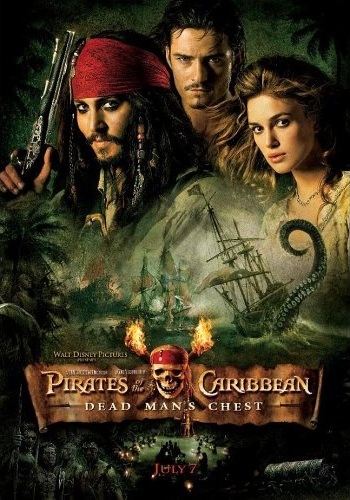
Pirates
of
the Caribbean - Dead Man's Chest
This is
a Walt Disney film starring
Johnny Depp, Keira Knightly and
Orlando Bloom, released for
general
cinema
viewing on Friday, July 7th 2006.
In it's first week it broke all
records for box office revenue.
This
film is the sequel
to the first Pirates of the
Caribbean film - The Curse of
the Black
Pearl.
Much
of the film was shot
on location on the small,
English speaking, East Caribbean
island of
Dominica (not
to be confused with the
Spanish speaking Dominican
Republic), along
with some shooting of the 3rd
film in the series, At
World's End,
released on 2nd May, 2007.

Below
is a review of Dead
Man's Chest, written by
Polly Pattullo for
publication in
the
Saturday, 8th July, 2006 edition
of the U.K.'s Guardian
newspaper.

Sparrow's
nest
Dominica's
untamed
rainforests and secret coves
made it the perfect pirate's
lair
for Disney's latest blockbuster
Polly
Pattullo
Saturday
July
8, 2006
The
Guardian
(U.K.)
Last
year, on the south-west
coast of the Caribbean
island of
Dominica,
the
Disney Corporation built
a "cannibal village"
scattered across
two
hillsides,
linked together by an
80ft-high rope bridge
and overlooking
the
sea.
Elaborate, two-headed
teepees, covered in
twisted tree roots
and
adorned
with skull motifs and
bones, were to provide a
very temporary
refuge
for Johnny Depp's
Captain Jack Sparrow at
the start of Pirates
Of
The
Caribbean: Dead Man's
Chest. Depp appears
gloriously enthroned
-
before
escaping from a
roasting. Now, just an
island memory, the
crazy
tepees,
along with an
accompanying spit, have
disappeared under
swathes
of
lemon grass. The bush
reclaims even Disney's
fantastical footprint. |
 |
Lying
between
Guadeloupe and Martinique,
Dominica, with its volcanic
mountains
clothed in rainforest and veined
with rivers and waterfalls, is,
in
fact,
not unlike Depp's Sparrow:
charismatic, beguiling,
unknowable. And for
just those reasons, it was
chosen as a location for both
Pirates 2,
which
opened this week, and, coming
next year, Pirates 3. "We
selected
Dominica
because it's beautiful and
virtually untouched - and
totally
undiscovered
by film-makers," said producer
Jerry Bruckheimer.
Which
is
not quite true. In 1990, it
featured in Channel 4's drama,
The
Orchid
House, and in 1949, was seen in
Frederick Marsh's Columbus, when
Woodford
Hill Bay, a narrow strip of
white sand beach in the north of
the
island,
became Columbus' first footfall
in the new world. No matter that
Columbus
never landed on Dominica on his
second voyage in 1493 - although
he saw
it, and gave it a name.
In
Columbus, the "natives" were
played by Caribs (or Kalinago)
people, the
indigenous peoples of the
Caribbean and the descendants of
those who
might
have encountered Columbus
himself. Unlike in most of the
rest of the
region,
the Caribs of Dominica have
survived, and now have their own
Territory
in the north-east of the island.
They are proud of their identity
and
while,
in 1949, the only controversy
was that two versions were
filmed - one
with
topless women (for Europe), the
other with tops on (for the US
market)
- in 2005, things were rather
different. Many Caribs
participated in
Pirates
2 but their chief, Charles
Williams, criticised Disney for
what he saw
as perpetuating the myth that
the Carib people were cannibals.
Disney
retorted
by saying that both locations
and peoples in the film were
fictitious.
Woodford
Hill,
which remains almost the same
today - empty, except for a few
fishing
boats pulled up on the sand -
played no part in Pirates but on
nearby
Hampstead
beach, Depp engages in a sword
fight (inside a runaway water
wheel),
which,
in fact, begins elsewhere - on
an isolated peninsula below the
village
of Veille Case where the
film-makers built an
extraordinary ruined
church.
Another
location
was the Indian River. Visitors
have rowed up this gorgeous,
silent
waterway edged with mangroves
since pre-Columbian times, for
it was
once
the gateway to a large
Amerindian village, whose carbet
(communal
longhouse)
had room for 150 hammocks. For
Pirates 2, the river was lit
with
candles
and edged with tree houses for
the film's final eerie
sequences.
At
the mouth of the Indian River
lies Portsmouth, Dominica's
second town.
From the 16th century, this
provided a key stop-over point
(the
Atlantic
trade winds blow through the
channel north of Dominica): for
the
Spanish
on their way to and from their
plunders in the Americas, for
English
adventurers
such as Francis Drake, slavers
such as John Hawkins,
missionaries, and,
of course, pirates. Indeed,
Portsmouth still retains
something of a
raffish
air.
Further
north
on this spectacular coast is
where Captain Sparrow's very own
-
and
newly decked out - Black Pearl,
ventured in 2005, sailing under
the
Capuchin
cliffs. One Dominican extra who
spent time on the Black Pearl
was
Lennox
Honychurch, anthropologist and
historian. He and the other
extras
learned
how to tie ropes, climb rigging
and hoist sails for a scene in
Pirates
3. "Then for filming we spent
time criss-crossing the deck
with Johnny
Depp," said Honychurch. "The
weather was perfect. We sailed
very close
to the cliffs and it was
spectacular." But dangerous. In
1567, six
Spanish
vessels were wrecked there in a
hurricane. It was said that the
Caribs
stripped the boats of treasure -
and buried it. One witness,
questioned
later, claimed that "the silver
was so high that a man on a
horse could
not be seen from the other
side."
Disney
brought
a bit of its own treasure to
Dominica, an island struggling
in
the wake of globalisation and
the collapse of its banana
industry: at
least
some of the film's US$300m
budget - three times more than
the
government's
annual expenditure - went on the
logistics of housing, feeding
and
servicing
an army of actors and
technicians. Depp, meanwhile,
stayed on his
yacht.
Yet gossip has it that he was
seen as an affable figure among
the
locals.
For example, he chilled out at
Indigo Cottages, perched on a
steep
slope
three miles from Portsmouth -
and did the washing up. Owned by
Clem
Frederick,
a Rastafarian, and his
French-born artist wife, Marie,
its buildings,
including
an open-sided art gallery with
furniture made of driftwood, are
set in
a glittering fairy glade of
tropical plants. Depp was
generous with his
time; and many a home can boast
a photograph of Depp shoulder to
shoulder
with a Dominican extra, both
grinning like old mates at the
camera.
Disney's
stay
in Dominica forged its own
stories, not least the man whose
job it
was to harvest coconuts lest
they should fall on a Hollywood
head: he
earned
enough money to build a small
house. And then there was a
make-up
artist
who asked where the malls were
and was told there were none.
Desolate
she
was; delighted should we be.
And
even
if Keith Richards never made it
to Dominica - although he is
said
to be playing a cameo part, as
Sparrow's father, in Pirates 3 -
Mick
Jagger
did. Some years ago, he hiked to
the Boiling Lake, a steaming
volcanic
crater in the island's great
green interior. At the end of
Pirates 2,
Depp's
disciples swear that they will
go to the ends of the earth to
resurrect
Sparrow and the Black Pearl.
Perhaps they will all turn up at
the
Boiling
Lake. Meanwhile, it's there for
the rest of us.
·
British
Airways, Virgin and BWIA fly to
Antigua; then take Caribbean
Star
or Liat for a 40-minute onward
flight. Trips Worldwide
(tripsworldwide.co.uk)
puts together tailor-made tours
to Dominica. piratesdominica.com
provides
general information about
Dominica, including
accommodation and its
piratical
history.
·
The
Ethical Travel Guide: Your
Passport To Alternative Holidays
by
Polly
Pattullo with Orely Minelli is
published by Tourism
Concern/Earthscan
at
£12.99.
Polly
Pattullo is also author
of 'Last
Resorts', a
study of the
impact of
tourism
on the Caribbean.
This well written and
extensively
researched
work
takes a look at
the history of tourism
in the region and weighs
the
the
economic benefits
of modern day tourism
against the cost to
the
environment
and
the effects
upon the local
populations, their
politics,
cultures
and traditions.
Of
particular significance
is the 'Cruise Ship'
phenomena, a
booming
industry
which began
life providing an
alternative vacation
style for the
wealthy,
but which now
caters almost
exclusively to a massive
economy
class
market. The 'All
Inclusive'
packages now bring
hoards of visitors
to
our shores, most with
full stomachs and empty
pockets.
First
published in the
mid 90's, it has
been comprehensively
updated
and
revised for a Second
Edition,
published in 2005 in
the U.K. by
Latin
America Bureau.
|

|
|